A major US utility managing wildfire-season power shutoffs was coordinating communications manually across dozens of stakeholders, channels, and regulatory requirements. We automated the full communication workflow from a single operational interface. Zero communication-related fines on the next event.

Geography United States
Exceeding $20B annually; millions of customers served
Environment Large-scale grid operations across wildfire-prone regions with strict regulatory oversight
Existing Palantir Foundry customer. This engagement expanded the platform to support PSPS communication operations
Multi-day wildfire shutoff events requiring coordinated communications across customers, government agencies, and internal operational teams
The Situation
Public Safety Power Shutoff events are one of the most operationally complex processes utilities must manage. When wildfire risk conditions escalate, utilities may intentionally shut off power to prevent infrastructure from igniting fires. These events trigger a multi-day sequence that includes preparing operational plans, issuing warnings to affected customers, coordinating with government agencies, and restoring service once conditions improve.
During these phases, the utility must execute numerous communication steps across multiple channels: customer notifications, website alerts, IVR updates, regulatory reporting, and coordination with county, city, and tribal government agencies.
The operational complexity grows rapidly. PSPS events involve multiple planning scenarios, geographic impact zones, and timing windows. Different combinations of plans, phases, and locations create hundreds of possible operational situations that must be managed correctly. Even small coordination mistakes carry serious consequences. Communication failures can result in substantial financial penalties and public safety risk.
The Friction
The utility already had a Workshop-based interface within Palantir Foundry to track PSPS communication activities. Teams could monitor event status and see which communications had been initiated.
However, much of the operational work behind those communications still happened outside the platform. Teams were manually generating datasets and preparing files required for different channels. County-level CSV files, geographic shape files, and regulatory reports were created by different teams using separate processes and tools. This created significant coordination overhead, particularly during time-sensitive phases of an event.
A second problem was scenario complexity. PSPS events combine planning scenarios, event phases, staging steps, and geographic impact areas into hundreds of possible workflow permutations. Not all of them were captured clearly in the existing system.
Compliance tracking was also difficult to manage consistently. Because communications were triggered across multiple teams and systems, maintaining a clear record of timing, responsible users, and regulatory compliance was hard. The organisation had visibility into what was happening. It did not have a system capable of orchestrating the full communication workflow.
The Process
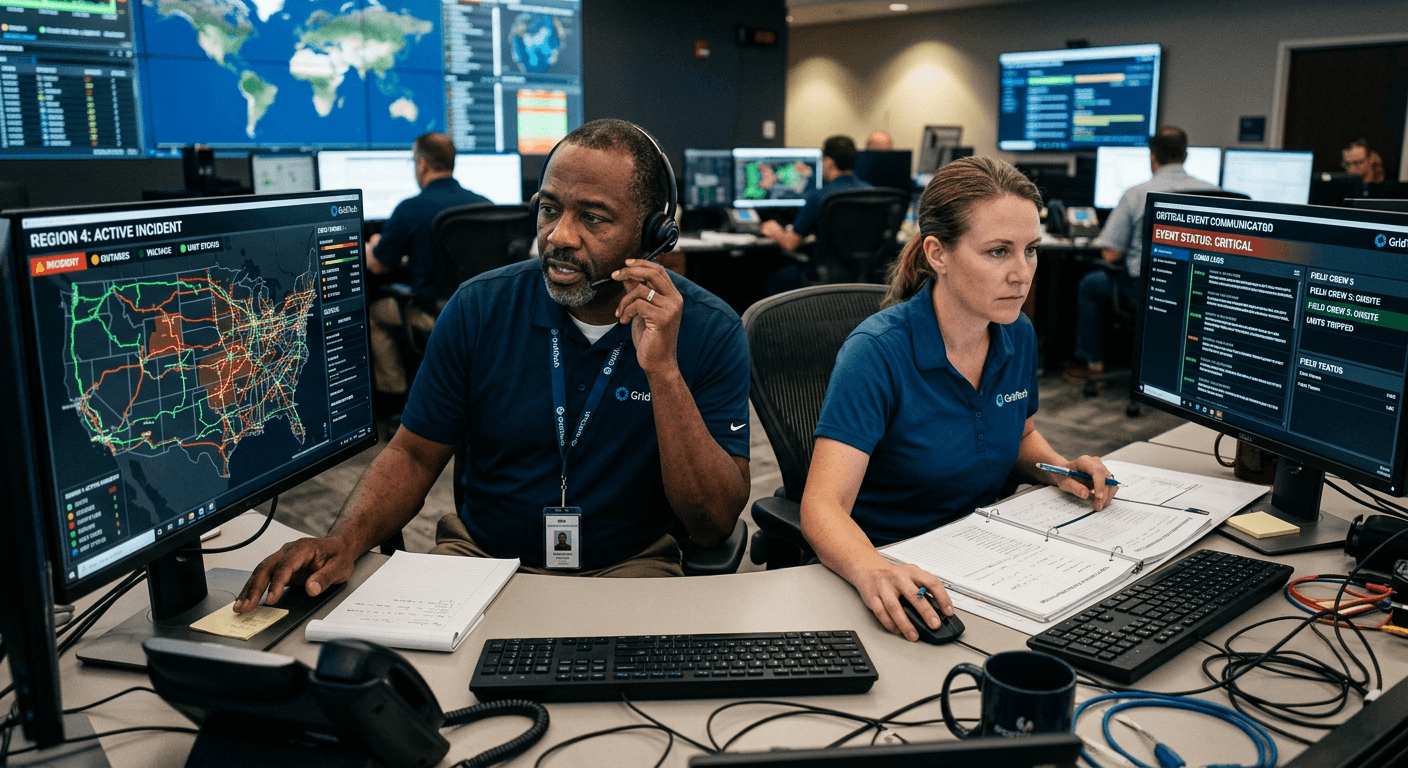
This engagement expanded the existing Foundry implementation by transforming the Workshop-based tracking interface into an automated PSPS Communication Command Center. Instead of using Workshop only to observe progress, the platform was connected to backend jobs so that actions in the interface trigger the required communication workflows automatically.
Parameter-driven workflow execution
Operators initiate communication sequences by selecting the active PSPS scenario: plan type, event phase, and geographic impact area. Once triggered, the system automatically launches backend jobs that generate required outputs for multiple communication channels.
Automated communication outputs
The platform generates operational artefacts previously created manually by separate teams: customer communication datasets, regulatory reporting files, geographic impact data, and operational communication outputs. Teams no longer prepare files independently across systems.
Scenario-based operational visibility
The system captures the full range of PSPS operational scenarios within the platform. Operators can see which scenario is active, which communications are required, and what actions must be executed next. Situational awareness during active wildfire events is significantly improved.
Centrally governed decision layer
Communication actions are initiated and governed within the same operational environment rather than coordinated across separate tools. Every communication sequence records timestamps, responsible users, and execution status. The full decision layer is auditable.
Closed-loop execution tracking
The platform tracks each communication sequence from initiation through completion. All actions and outcomes are captured in the system, creating an operational record that can be analysed to improve future PSPS event management.
The Outcome
|
Day to day, operators stopped using Workshop as a manual tracking layer. The platform became the place where PSPS communication workflows were initiated, governed, and tracked. Teams spent less time preparing communication artefacts and manually coordinating across groups, and more time managing the event itself.
The compliance improvement was material. By automating the communication sequence, centralising execution, and maintaining full auditability across each step, the utility significantly reduced regulatory exposure during PSPS events.